The 3 a.m. call: why every founder needs an Arun
· 6 min read · by Rahul Dhileep Kumar
When I'm stuck badly enough, I call Arun, our CTO. He picks up at any hour. Why every founder needs that one person, what the research says about trust in founding teams, and how to make the 3 a.m. call rarer.
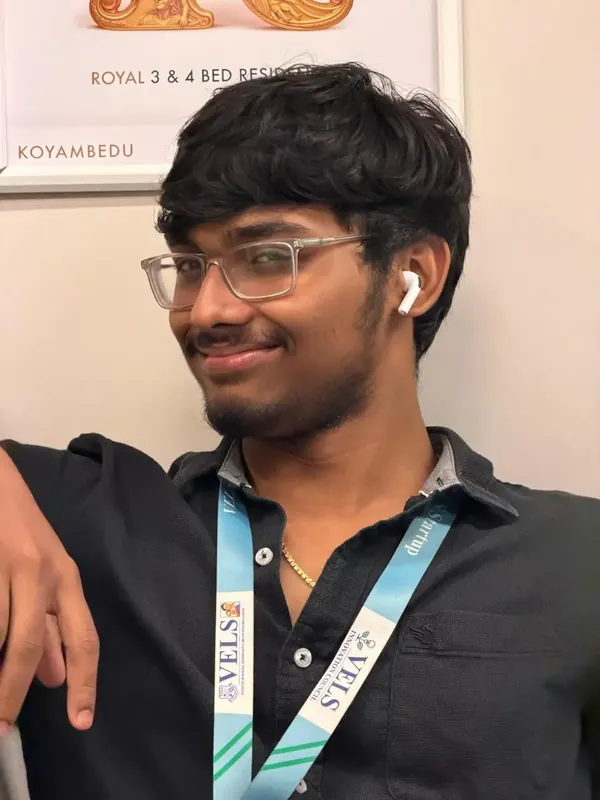
When I'm stuck badly enough, I call Arun. He's our CTO. He's the one person I trust to pick up at any hour.
In the night I broke production, he got a short section. Four lines and a photo. This is the longer version, because I think the idea deserves more than four lines.
The idea is simple. Every founder needs one person who picks up. Not a mentor you email on Mondays. Not a group chat. One person, at any hour, who will actually answer.
The one person who picks up
Arun picks up at any hour. Which, if you think about it, is frankly suspicious. Does he sleep? Is he three people? I've decided not to ask, in case the answer ruins it.
If you want to know who he is, his portfolio does a better job than I would.
What I think a person like that gives a founder is a floor. "Stuck" stops meaning "stuck forever". The bad nights still happen. They just have a bottom.
TrackMy Tech is bootstrapped. There's no board of investors waiting by the phone. There's Arichandran, our co-founder and director, there's Arun, and there's the rest of us. When something breaks, the people in the room are the plan.
Why going it alone is harder than it looks
I'm not the first person to notice this. Paul Graham put "single founder" near the top of his essay The 18 Mistakes That Kill Startups. His reasoning is blunt. "Starting a startup is too hard for one person." Even if you could do all the work yourself, he says, you need colleagues "to brainstorm with, to talk you out of stupid decisions, and to cheer you up when things go wrong."
That last part is the 3 a.m. call in one sentence.
He also writes that "the low points in a startup are so low that few could bear them alone." I've had a few low points. I can confirm they are, in fact, low.
The catch: the people can also sink you
Here's the uncomfortable flip side. The people around you aren't only your safety net. They can also be the thing that breaks.
Noam Wasserman, who wrote The Founder's Dilemmas, has studied this for years. The Harvard Crimson reported that his research drew on data from "nearly 10,000 founders of technology and life sciences startups in the U.S." His main finding, as the Crimson summed it up: "Startup companies are most likely to fail due to personal disagreements within their management teams."
Not the market. Not the tech. The people.
The same article notes that 73 percent of founders in his survey decided how to split equity in the first month. An equal split avoids tension early on, but can cause problems if a co-founder backs out later. In other words: the hard conversations don't go away if you skip them. They just wait for a worse moment.
So I don't think the lesson is "have a co-founder, done". I think it's "have someone you trust, and do the work to keep that trust".
Trust is what makes the call possible
There's a reason the 3 a.m. call works with one person and not with others. You have to be willing to say "I've messed this up and I don't know why" out loud.
Amy Edmondson has a name for the condition that makes that possible. In her 1999 paper she describes team psychological safety as "a shared belief held by members of a team that the team is safe for interpersonal risk taking." She studied 51 work teams in a manufacturing company. Teams with more psychological safety showed more learning behaviour, and that learning behaviour was linked to better team performance.
Her examples of learning behaviour are worth reading slowly: seeking feedback, sharing information, asking for help, talking about errors and experimenting.
"Asking for help" and "talking about errors" are basically the job description of a 3 a.m. call. If you're scared of looking stupid, you don't call. You sit there alone for hours, checking the same code again.
Photo: Pathum Danthanarayana on Unsplash
What I'd tell another founder
None of this is a grand theory. It's my opinion, from someone who makes that call when he's stuck badly enough.
- Decide who you'll call before the crisis. Not during it. In the middle of an outage you won't think clearly enough to pick. Know the name now.
- Make it mutual. If you only ever call, it's not trust, it's a helpline. Pick up for them too. Be the person who answers.
- Say the embarrassing thing early. The call only helps if you're honest about how badly it's gone. Edmondson's research is basically a long argument for this.
- Have the awkward talks on a calm day. Equity, roles, who decides what. Wasserman's findings suggest the skipped conversations are the ones that come back.
- Write things down so the call is rarer. Passwords in the right place, deployment steps, when certificates expire, how to roll back. If the answer lives in one person's head, that person gets woken up a lot.
That last one matters more than it sounds. The goal isn't to call Arun more. The goal is to call him only when it really can't wait. He picks up at any hour. That doesn't mean he should have to.
One last thing
Find your Arun. Then try very hard to need him less.
And if you already have one, maybe send them a thank-you message. During the day, for once.
FAQ
Do you need a co-founder to start a startup?
Not strictly. But Paul Graham lists "single founder" as one of the mistakes that kill startups, mainly because the low points are hard to carry alone. At the very least, have one person you can call.
What is psychological safety in a team?
Amy Edmondson defines it as a shared belief that the team is safe for interpersonal risk taking. In practice: you can admit a mistake or ask for help without being punished for it.
How do you make late-night emergencies rarer?
Write things down. Deployment steps, credentials, renewal dates and rollback commands should live somewhere the whole team can find them, not in one person's head.
Sources
- Paul Graham: The 18 Mistakes That Kill Startups
- The Harvard Crimson: Noam Wasserman on founders (2012)
- Amy Edmondson: Psychological Safety and Learning Behavior in Work Teams, Administrative Science Quarterly (1999)
What next
The outage night, in full: we blamed our code, it was SSL. Another late-night call, from the other side: I said I would help a friend.
Running an academy? Track My Academy handles attendance, fees, player reports and parent messages. It's built by TrackMy Tech.