R.I.P. smart ball v1: what smart football sensors taught me
· 7 min read · by Rahul Dhileep Kumar
I spent a year trying to put smart football sensors inside a ball. Piezo sensors, a breadboard, my first ever solder joint. It never shipped. Here's the eulogy, plus what I learned about hardware prototyping.
We are gathered here today to remember smart ball v1.
It was a football.
It had smart football sensors inside.
It never shipped.
Rest in peace, little guy.
This is the eulogy, and also a beginner's guide to why hardware is hard.
If you have ever wanted to stuff electronics into a football, read this first.
It will save you some wires.
Possibly some eyebrows.
The idea: a football that knows it was kicked
I love football.
I love building things.
So naturally, I thought, "What if the ball itself was smart?"
A low-cost football with sensors inside.
Something that could tell you about every touch.
How hard could it be?
Very.
The answer is very.
This was not a weekend hack, either.
Smart Football R&D ran from December 2024 to December 2025.
A full year of my life, inside a ball.
It ran alongside Track My Academy, which I was building at the same time.
That one started because a coach complained about attendance.
So yes, two big projects at once.
One of them was round.
What was inside smart ball v1
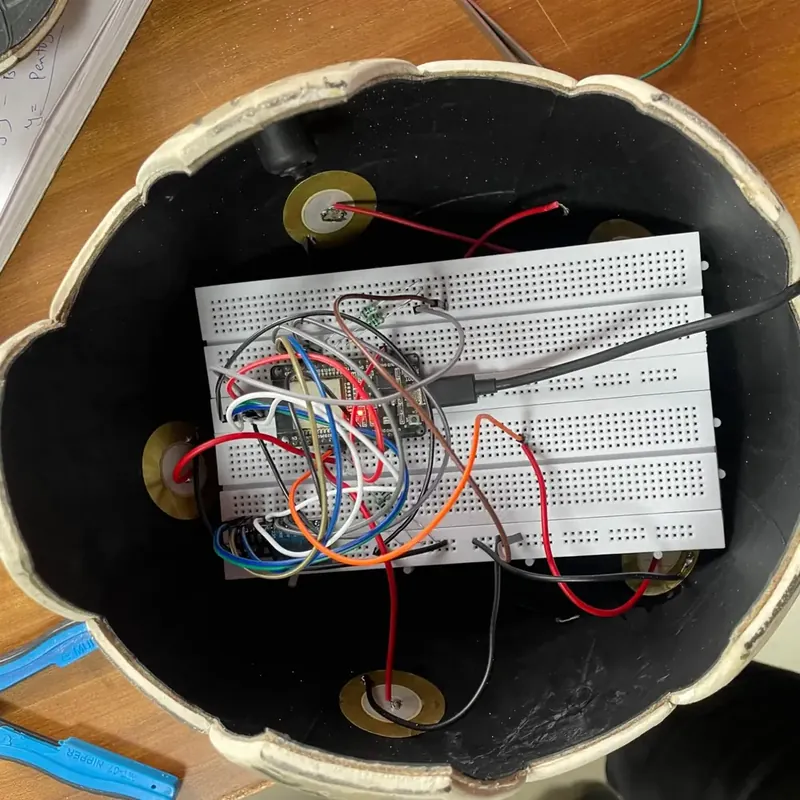
Look at the photo above.
That's an open football shell.
Inside, there are piezo sensors around the edges.
In the middle, a breadboard covered in wires.
Lots of wires.
More wires than any football should legally contain.
Piezo sensors turn pressure into a small electrical signal.
Kick the ball, the sensor reacts.
At least, that's the theory.
Theory and breadboards are not always on speaking terms.
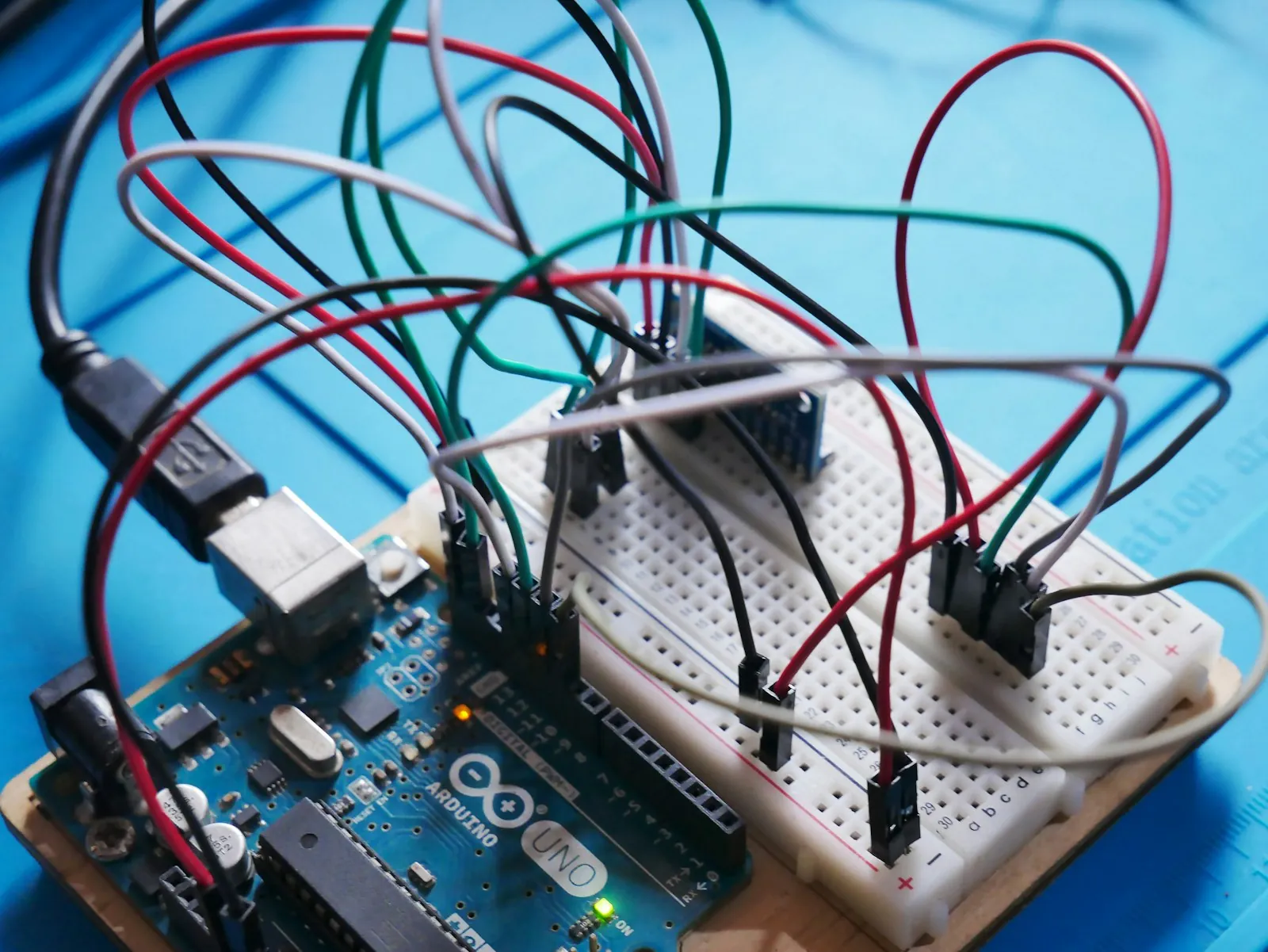
Photo: Vishnu Mohanan on Unsplash
A breadboard is brilliant for prototyping.
You push wires in, no soldering needed, and you can reuse it.
Wikipedia also politely notes its connections are "subject to jostle".
Jostle.
In a football.
The object whose entire job is being kicked.
You can see where this is going.
The year in one list
People imagine hardware R&D as one big "eureka".
It's more like a long list of small "oh no".
Here is what that year actually covered:
- Sensor selection. Which sensor, how many, and what it should even measure.
- Component placement. Where everything sits inside a sphere that gets booted.
- Ball balance. Add weight on one side and the ball stops rolling straight.
- Bladder and pressure research. The air inside changes how everything behaves.
- Prototype testing. Kick it, check it, fix it, repeat.
- App dashboard concepts. What a player or coach would actually see afterwards.
Every item on that list could be its own engineering degree.
I had a breadboard and optimism.
Ball balance was the sneaky one.
In software, a heavy function makes things slow.
In a football, a heavy component makes it wobble.
Nobody wants a ball that curves because of your circuit.
IMU vs piezo sensors: two ways to make a ball feel things
There are two common ways to give a ball a sense of touch.
Piezo sensors react to pressure and impact.
They are cheap, simple and good at noticing a sudden hit.
The catch: they cannot do truly static measurements.
They notice the kick, not the gentle story after it.
An IMU is an inertial measurement unit.
It combines accelerometers, gyroscopes and sometimes magnetometers.
It measures how the object moves and rotates.
The catch there is drift.
Tiny measurement errors pile up over time.
The device slowly loses track of where it really is.
So, roughly:
| Piezo sensor | IMU | |
|---|---|---|
| Good at | Detecting impacts and pressure | Motion, spin and orientation |
| Weak at | Static or slow measurements | Drift over time |
| Beginner-friendly | Very | Less so |
My opinion: piezo is the friendly place to start.
An IMU is where the serious connected ball technology lives.
Meanwhile, the professionals
While I was fighting wires, real sports tech was doing real things.
At the 2022 World Cup, the match ball had an IMU sensor in its centre.
According to FIFA, it sent data 500 times per second.
That helped detect the exact moment a ball was kicked, for offside calls.
adidas says a suspension system held that sensor steady at the centre.
It ran on a rechargeable battery, charged by induction.
Read that again.
They suspended a sensor in the middle of a ball.
That is the ball balance problem, solved properly.
500 times per second.
My prototype struggled to report once without a wire falling off.
Humbling?
Yes.
Inspiring?
Also yes.
Photo: Jason Mayer on Unsplash
I learned to solder (soldering safety first)
Before this project, I had never soldered anything.
Complete beginner.
Absolute zero.
The smart ball got me soldering.
I look like a scientist.
I solder like a nervous chef.
But I learned.
Slowly.
If you're a beginner too, here's the bit to take seriously.
A soldering iron runs roughly between 200 and 480 °C.
That is not a "quick touch to check" temperature.
Hold it by the handle and put it back in its stand.
The fumes matter too.
The UK's Health and Safety Executive is blunt about it.
Rosin solder flux fume can cause asthma and dermatitis.
Their advice is simple: keep your face out of the fume and use extraction.
So my beginner soldering safety list:
- Safety glasses on, every time.
- Ventilation or a fume extractor.
- Iron goes back in the stand.
- Wash your hands after handling solder.
- Never assume the tip has cooled down.
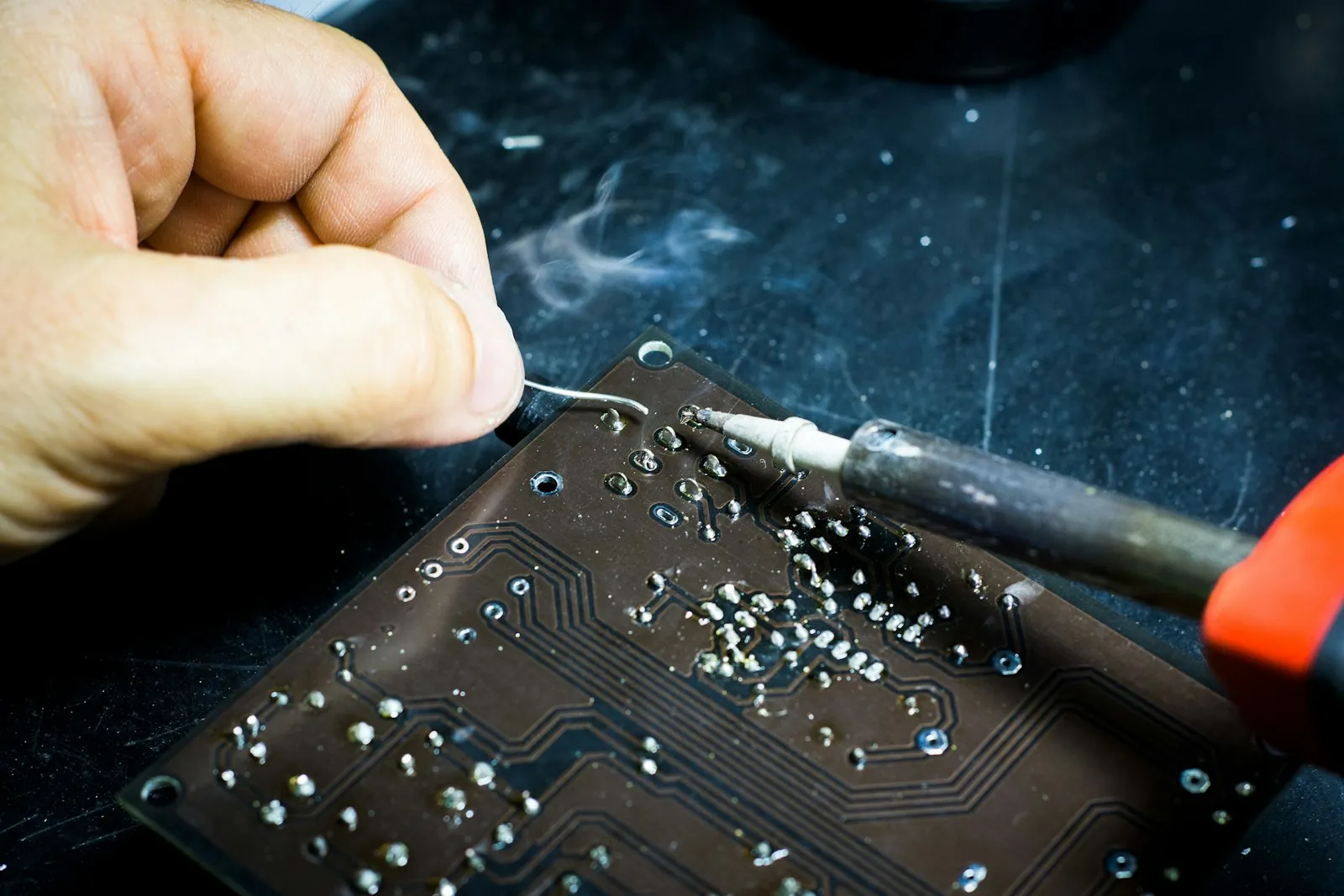
Photo: Blaz Erzetic on Unsplash
Why hardware is hard (and why v1 never shipped)
Hardware is hard.
Everyone says it.
Now I get it.
With software, a mistake costs you a deploy.
With hardware, a mistake costs you a ball.
Software also forgives you faster.
When I broke production for hours, at least nothing physical died.
You can't hotfix a solder joint over Wi-Fi.
Hardware also costs money at every single step.
Parts, more parts, replacement parts for the parts you fried.
In the end, the smart football project was paused due to funding constraints.
That's the honest version.
No dramatic explosion.
Just a very sensible spreadsheet.
Smart ball v1 was never finished.
But it was never meant to be the final version.
That's what v1 is for.
Hardware prototyping for beginners: what I'd tell you
Building teaches you what reading can't.
I understood sensors only after I wired one wrong.
I learn by doing things badly first.
Same energy as rebuilding the app that looked like 2006.
Start on a breadboard, finish on solder.
Breadboards are for finding out.
Solder is for when you've found out.
Think about where the thing lives.
A circuit on a desk is easy.
A circuit inside a ball gets kicked, squashed and rained on.
Prototypes are allowed to die.
Their job is to teach you, not to survive.
Respect hardware people.
Anyone who ships a physical product is a wizard.
I'm still at the "please don't short-circuit" stage.
FAQ
What sensors are used in smart footballs?
Mostly IMUs, which track motion and spin.
The 2022 World Cup ball used one sampling 500 times per second.
Piezo sensors are a cheaper way to detect impacts, which is where I started.
Is a smart football hard to build as a beginner?
A basic "did it get kicked" prototype is doable.
A balanced, durable ball that survives real matches is properly hard.
Budget for broken parts and broken pride.
Is soldering safe for beginners?
It can be, with basic care.
Wear eye protection, keep your face out of the fume and use ventilation.
Treat the iron like it's always hot, because it usually is.
The funeral is over
Smart ball v1 lives on in my heart.
And in a drawer, probably.
I still think about the idea.
I still watch football and think about sensors.
Building Veeran made that worse, as I explain in this post.
V2 might happen someday.
Sports tech is the whole point of TrackMy Tech, so never say never.
Until then, I'll keep the safety glasses close.
Building something in sports tech, hardware or software?
Book a call with me and we can compare scars.