Switching from biology to computer science, with zero plan
· 6 min read · by Rahul Dhileep Kumar
I was a class 12 bio-maths student. Then I ended up switching from biology to computer science, doing B.Tech AI and Data Science and building software. What helped, what didn't, and what I'd tell anyone choosing a stream after class 12.
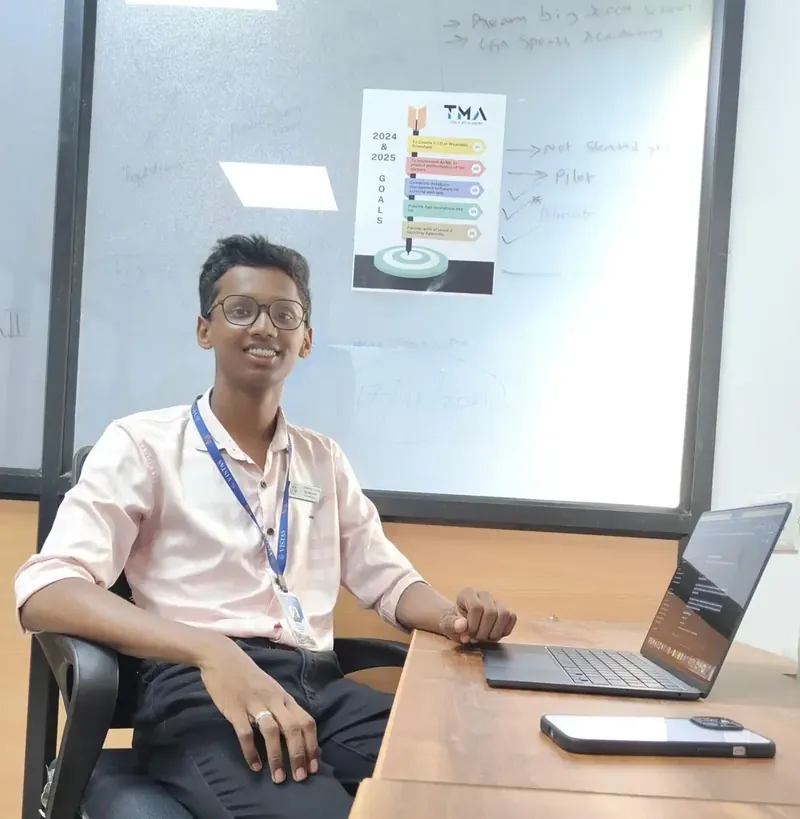
In class 12, I was a bio-maths student.
Biology and maths. The combination that says, "I haven't decided yet."
Then I ended up switching from biology to computer science.
No plan, no grand vision, no robot built from spare parts at age nine.
This post is the honest version of that switch.
It's also for anyone choosing a stream after class 12.
Or anyone eyeing a career change into tech from somewhere else entirely.
Choosing a stream after class 12 (badly, in my case)
Bio-maths is the stream you pick to keep every door open.
Doctor? Possible. Engineer? Also possible.
Decision? Postponed, indefinitely.
That was me.
I had a timetable and a vague feeling.
I didn't wake up one morning in love with computers.
There was no dramatic movie moment.
I just ended up in computer science.
That's it. That's the origin story.
Hollywood will not be calling.
Today I'm doing a B.Tech in Artificial Intelligence and Data Science.
Which sounds very impressive on paper.
On paper, I also look like someone who sleeps eight hours.
Would I do it again?
Yes. Instantly.
Best decision I have ever taken, I guess.
The "I guess" is doing a lot of heavy lifting there.
Photo: Pawel Czerwinski on Unsplash
What biology and maths quietly taught me about code
People assume switching from biology to computer science wastes the first part.
I don't think it does.
Biology teaches you that systems are messy.
Nothing works the way the diagram says it does.
Everything depends on something else you forgot about.
Which, it turns out, is also a perfect description of software.
Maths taught me that being wrong is normal.
You just keep going until the answer stops being wrong.
Debugging is the same thing, but with more caffeine.
There's even a whole field where the two subjects meet.
Computational biology studies living systems using computer science, data analysis and simulation.
Its cousin, bioinformatics, builds software tools for huge biological datasets.
So no, the biology years were not a detour.
They were a weird, scenic shortcut.
Photo: Bozhin Karaivanov on Unsplash
Can a bio-maths student do B.Tech in computer science?
Short answer: usually, yes.
Long answer: check the fine print, because India loves fine print.
Bio-maths students normally study physics and chemistry too.
With maths, that's the classic engineering set, so most doors stay open.
In 2021, AICTE also relaxed its B.Tech eligibility rules.
Its handbook listed biology among 14 subjects that could count.
But the change was optional.
States, universities and JEE Main could still insist on physics and maths.
So here's my advice, and it's boring on purpose.
Read the admission brochure of the exact college you want.
Then read it again, slowly, like it owes you money.
What B.Tech AI and Data Science actually is
My degree is a B.Tech in AI and Data Science.
It's computer science with extra statistics, extra maths and extra hype.
Data science mixes statistics, scientific computing, algorithms and coding.
The goal is to pull useful knowledge out of messy data.
It also leans on domain knowledge from whatever field the data comes from.
That last bit matters if you're coming from a non-CS background.
Your biology, commerce or arts brain is not a handicap.
It's the domain knowledge.
Data without context is just a very large spreadsheet.
Should everyone pick AI and Data Science? No.
If you like building things, any CS-flavoured branch will do.
The branch name matters far less than what you build during it.

Photo: Vitaly Gariev on Unsplash
Learning to code from a non-CS background
Here's the part nobody tells you.
I learn by touching the thing until it makes sense.
I do it badly first.
Then slightly less badly.
Then, eventually, well enough to ship.
That approach is basically my whole career.
We once hired someone to build Track My Academy.
What came back was PHP, and it looked like 2006.
So I decided to build it myself.
The first night was a MacBook Air, a second-hand iPhone, ChatGPT and VS Code.
Mostly research, then a landing page I actually liked.
Later, I built the Android and iOS apps myself.
Android is live in production. iOS is coming soon.
No certificate. Just apps, and a lot of Monster cans.
If you're starting from zero, here's what I'd actually do:
- Take one free foundation course. CS50 is free online and starts from scratch.
- Pick one language and stay there. Python is a friendly first choice.
- Skip the official Python tutorial at first. It says itself it's not for total beginners.
- Build something you'd actually use. A tracker, a bot, a page for your football team.
- Break it, fix it, repeat. That's the whole syllabus.
The CS50 page says two thirds of its students have never taken CS before.
So you'd be in very large, very confused company.
And yes, use AI tools.
Early on, we hunted down every free AI trial we could find.
Less elegant than it sounds. It worked.
Just understand the code before you ship it.
Production will teach you otherwise.
Ask me about the night I broke it.
Photo: Vishnu Kalanad on Unsplash
Biology found me again anyway
Here's the plot twist.
I left biology for computer science.
Then biology walked back in through the side door.
I'm now AI and Product Development Lead at BioPipeline.
It's a SaaS for plant molecular docking.
We built it from scratch with the founding team.
Compound uploads, docking runs, molecular interaction outputs, results.
It started because I said I would help a friend.
So the bio-maths kid ended up writing software for biologists.
The universe has a sense of humour.
Mostly at my expense.
Nothing went the way I expected
From the moment I switched, nothing followed a script.
I coached football part-time at an academy.
A coach's complaint about attendance and payments became an idea.
That idea became Track My Academy.
Then it became a company, TrackMy Tech.
I'm now its Executive Director, while still technically a student.
My mother still asks whether I went to class.
Fair question. Student founder life is like that.
None of this was in any plan.
I'd love to tell you I saw it coming.
I absolutely did not.
If you're choosing a stream after class 12 right now
You might be stuck between two streams.
Everyone has an opinion about what you should do.
Here's mine, and it's free.
The subject you pick at seventeen isn't a life sentence.
It's a starting point.
Pick something. Work hard at it.
If it doesn't fit, switch.
One more thing.
Be careful with "opportunities" that cost money.
I once paid for an internship.
Still annoyed about it.
Nobody checks your class 12 stream when your product works.
FAQ
Is switching from biology to computer science hard?
Harder at the start, honestly.
The first few months feel like learning a new language. Because they are.
After that, it's mostly practice and stubbornness.
Biology students already memorise ridiculous names. Variable names are easier.
Can I do B.Tech AI and Data Science after bio-maths?
Usually, yes, since bio-maths includes physics and maths.
AICTE allows more combinations now, but colleges and states decide.
Check the brochure of your exact college.
Do I need a CS background to learn coding?
No.
CS50 says most of its students start without one.
You need curiosity, a laptop and a high tolerance for being wrong.
Making the switch yourself?
If you want an honest second opinion, book a call with me.
Or see what I'm building at rahuldk.in.
And if you end up in computer science by accident?
Welcome. We have snacks.
Actually, we have Monster cans. Close enough.